Every mission through the Haitian mountain landscape ends with the same sentence.
Never again.
Many of you know that I have long been active in one of the most difficult to reach and dangerous regions of Bolivia, the Cordillera de Mandinga in Chuquisaca and Potosí. Yet the dangers I have encountered in Haiti far exceed those. Both countries need a lot of energy, courage and miracles of God to provide dedicated medical care in such desolated regions.
Ominous signs
The beginning of our most recent mission was rough. Our second-hand jeep, bought thanks to donations after the earthquake of January 2010, finally broke down after serving us well for numerous missions. We had no choice but to hire a second-hand jeep from the capital. The sharp stones on the steep sandy tracks quickly left us with two flat tires after only a few hours of driving. Soon after, we were confronted with a faulty brake system, during an unexpected heavy storm in the mountains. Thank God, the hand-brake I could use as co-pilot proved to be our saving grace. Eventually we had to abandon the hired jeep in the middle of the road, because the mud did not allow us to go further.
Onwards and upwards, with motorcycles
Out of options, we rented some old motorcycles from a group of young Haitian boys. The obstacles and mud in conjunction with the winding tracks made the small iron seat bounce uncontrollably, a torturous experience. These roads were truly beyond all imagination. It is a pity we couldn't take many pictures: we were too fast out of batteries, and due to all the hours of delay it was already dark. Then even the motorcycles could not move further through the mud and water.
On foot, and then horses
Haiti in the summer is usually extremely hot, but in the mountains the temperature can fall dramatically. We continued our expedition for hours in the mud through the storm. Our clothes were soaked and our muscles exhausted and tense because of the cold. Courage and motivation were beginning to fail us. Then, out of the blue, we came across a kind man in the dark who was willing to offer us his horses. I remained alert, very aware that I was sitting on the back of a malnourished animal that I did not know. I was reminded of my friend and colleague Dr. Marcos, who fell with his horse down a steep ravine in the Bolivian mountains some 15 years ago. Thankfully some trees saved the life of Dr. Marcos and the horse.
Some coffins crossed us downhill
It was at this moment that I spotted a group of men carrying some coffins coming downwards from the darkness. My team told me that some families literally sell the bodies to gangs of youth to get rid of the evil spirits of the dead that might return, and that the ashes are then knocked out. Christians are buried the normal traditional way. This was a very confrontational experience. I had seen babies and children in small coffins on these same mountain tracks before. Certainly, another person or child with feelings, hopes and dreams died again in sickness and pain, as no doctor is around in these mountainous regions.
The storm that raged since the beginning of our journey did not last all night. The bright moon and dancing fireflies led us along a misty path to the village of Manceaux, where we built a small clinic a few years ago. The villagers had expected us with anxiety for many hours, and received us so kindly. Before we fell into a deep sleep, they washed our feet and lower legs.
The medical work
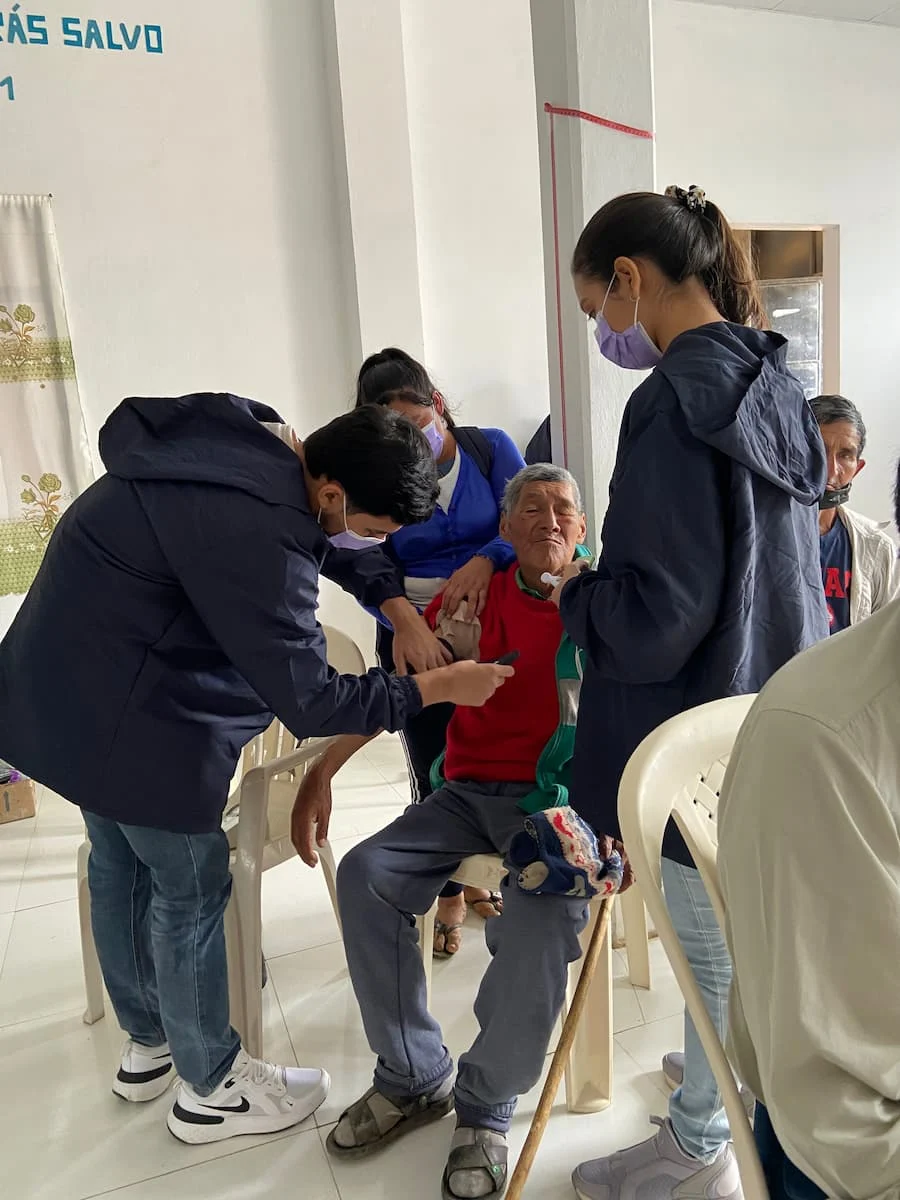
The next day our work began at the break of dawn till sunset. The consultations were marathon sessions with ten to fifteen patients per hour. Long lines of adults and children were waiting, some of which had travelled for days to see el Blanche, the doctor. Referring patients to a hospital is very difficult because of the costs. Transport is often around 1,000 Haitian Gourdes, a first consultation around 600, and a serious case needing lab tests and sometimes surgery comes to around 10,000 Gourdes, about US$150, for one patient. In our clinic in Manceaux we can only do the essential things, and our stock of medicines is empty as for now.
In many cases I am the first Caucasian and the first doctor that people have seen since I visited these villages after the devastating earthquake of January 2010, which left over 800,000 destroyed homes, 600,000 severely injured, and more or less 255,000 dead. Sadly, the many millions of dollars that were donated to help the Haitian people are not visible in the rural areas where they are most needed. Incredible to think that all this is happening on an island not two hours away from Miami.
The only doctor
This time there was no other Haitian doctor to accompany our mission. Some had immigrated to Florida and others from the team had found work in Port-au-Prince, as we cannot continue to pay their salaries, even if these are such small amounts. Fortunately I had several brave Haitian nurses, paramedics, pastors and interpreters by my side, young and driven Christian professionals led by their idealism. For example Miss Eliane; Miss means only that they are a nurse, nothing more. Because of her abilities, honesty and sincere personality the Doctors On Mission Haiti team decided to make her team leader.
To conclude: some great news
During the last eight months, my team managed to give the many orphans of Morency new and safe housing in several locations. This was necessary after the destruction of the orphanage and the clinic in Morency during the passing of Hurricane Matthew at the end of 2016.